The takeaway
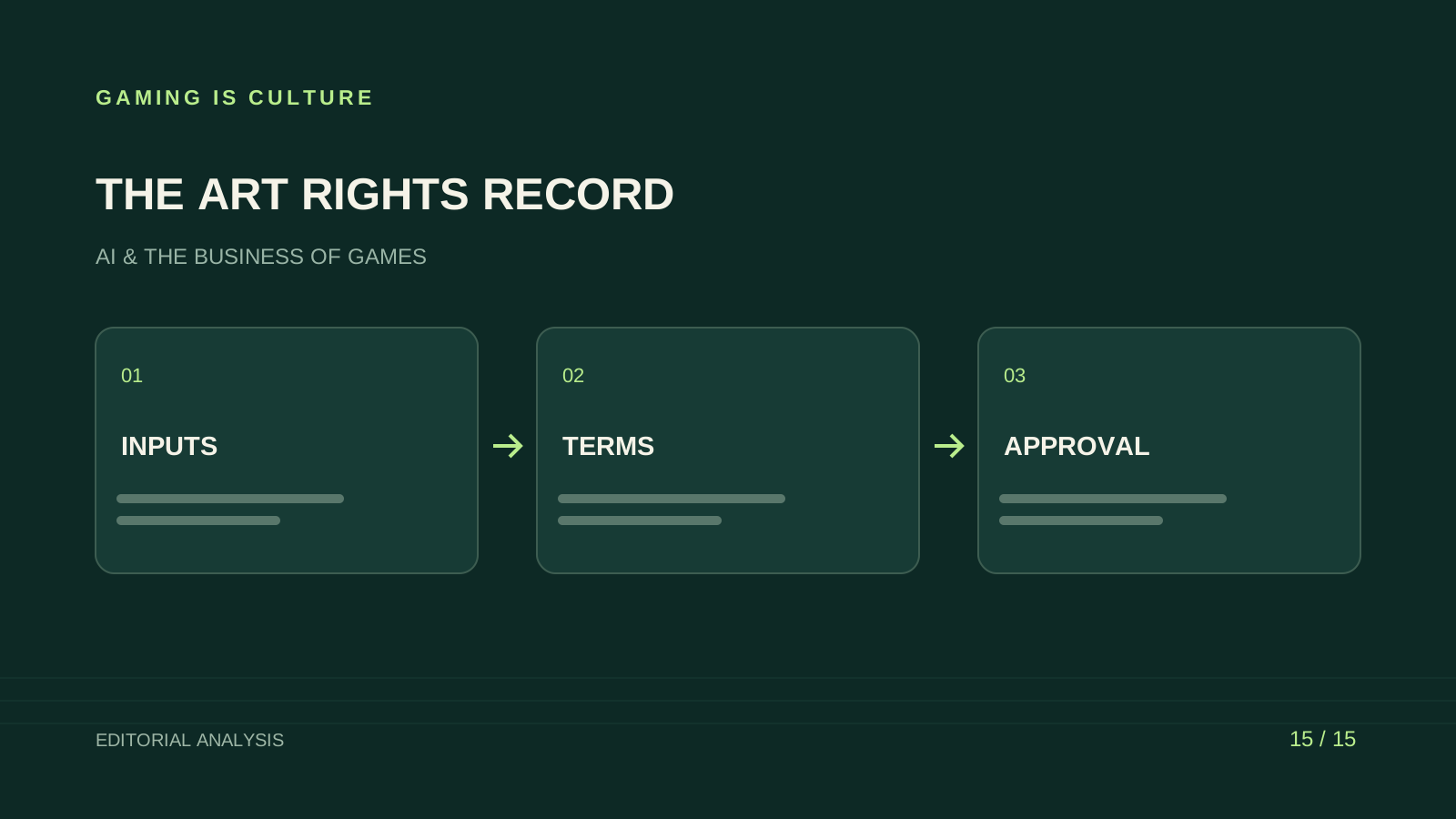
No art pipeline can guarantee that nobody will bring a claim. A studio can reduce avoidable exposure by controlling its inputs, reviewing vendor terms, documenting human work and obtaining advice for the assets it plans to ship. The headline describes the business concern; it isn't a promise of legal immunity.
AI art introduces several separate questions: permission to use the inputs, permission under the service contract, rights in the output and coverage if a dispute arises. This article is a US-focused production and procurement guide, providing general legal information. Advice for a particular game or agreement requires a qualified professional.
Start with the asset's intended use
An internal mood board, a store capsule and a shipped character texture have different consequences. Define the purpose before choosing the tool or uploading references.
List the required ownership, exclusivity and transfer rights. A publisher may need assurances about the assets included in the game. A contractor may have agreed to deliver work under specific production restrictions. Those requirements should shape the workflow from the beginning.
Keep final approval assigned to a person. A tool's output needs artistic, technical and rights review. The ability to generate a file doesn't establish that it belongs in the production.
Review inputs before generation
Reference images, sketches, photographs and existing game assets can carry different permissions. A file being publicly visible doesn't establish permission to upload it to a generation service or use it in commercial production.
Prefer material the studio owns or is authorized to use for the intended purpose. Check contractor agreements and stock licenses for relevant restrictions. For identifiable people, likeness and privacy issues can require separate review.
Record the source and permission beside the asset brief. If a reference can't be cleared, replace it before generation. Removing a questionable input early is easier than rebuilding a finished marketing campaign.
Commercial use and copyrightability are separate questions
A service may permit commercial use under its contract while copyright protection in the output remains a separate legal issue. A studio also needs to consider whether the output infringes someone else's rights.
The US Copyright Office's Part 2 report explains that copyright protection depends on sufficient human authorship. Using AI assistance doesn't automatically exclude a work from protection, while prompting alone doesn't necessarily establish authorship of the generated expression. The Copyright Office's report is the primary source.
A vendor's ownership wording should be read with that distinction in mind. Contractual allocation between the service and customer doesn't settle every question about enforceable rights against third parties.
Examine the exact vendor and model
A creative application can offer several models, including third-party services. The terms and protections may differ depending on the model, feature and purchase arrangement.
Adobe's Firefly product description identifies eligible features, surfaces and export events for its indemnity where the customer's agreement incorporates the relevant terms. Eligibility is contractual and feature-specific. Adobe's product description is a starting point for checking that scope.
Save the selected model, plan and relevant terms with the generation record. Avoid assuming that every output made inside the same application receives identical protection.
Read indemnity as a defined promise
An indemnity can allocate responsibility for certain claims under stated conditions. It has a scope, exclusions and procedures. It shouldn't be treated as an unlimited guarantee that an asset is safe.
Ask which claims are covered, who controls the defense, what notification is required and which uses fall outside the promise. Check how uploaded references, modifications, combinations and third-party models affect coverage under the exact agreement.
Have counsel review material terms for an important production. A summary on a marketing page can help identify a question, while the signed or applicable contract determines the arrangement.
Keep a record of human creative work
Save sketches, layered files, edits and documented decisions. These records help the team understand the production chain and identify the human contributions to the finished asset.
An artist might select a composition, paint substantial elements, rebuild forms and integrate the result into a coherent visual system. The legal significance depends on the work and jurisdiction; don't assume a particular amount of editing guarantees protection.
The production benefit is immediate even before a legal question arises. Another artist can revise a layered asset more easily than reconstructing a flattened output. Documentation supports maintenance as well as rights review.
Define the contractor's responsibilities
If contractors use AI, establish the permitted tools and uses in the brief or agreement. Specify disclosure, source records, reference permissions and deliverables the studio needs.
A generic promise to provide original work may leave uncertainty about the production process. Ask for a clear account of the tools used and the rights relied on. Review the agreement with appropriate advice for the project.
Keep the policy workable. A contractor should know which internal uses are allowed, which shipped uses need approval and who answers questions. Unclear rules encourage inconsistent decisions late in production.
Inspect the output for recognizable problems
Review for copied-looking characters, logos, distinctive designs, unexpected text and identifiable people. A visual check can't guarantee clearance, but it can catch obvious issues before they spread through the asset library.
Use the studio's art direction and approved references to evaluate originality and fit. Avoid briefs that ask for a close imitation of a recognizable protected character or another game's branding.
If a concern appears, quarantine the asset and investigate. Keep a replacement route. A late discovery is easier to handle when the team knows where the asset is used and which exports contain it.
Insurance needs a specific conversation
A studio's existing insurance may or may not cover relevant media, intellectual-property or technology claims. Coverage depends on the policy wording, exclusions, disclosures and circumstances.
Ask a qualified broker to review the proposed workflow and the relevant policies. Describe the tools, input sources, contractor use and distribution plans accurately. Obtain answers tied to the policy, with material exclusions explained.
Vendor indemnity and insurance can address different parts of a dispute. Don't assume one fills every gap in the other. Keep the broker and legal review focused on the assets and activities the studio plans to undertake.
Model the cost of a controlled pipeline
Consider a hypothetical batch of twenty marketing images. Assume a chosen $60 software allowance, ten artist hours for selection and revision, four hours for production review and two hours for recordkeeping. At an illustrative $45 hourly planning rate, the modeled total is $780 before legal review, insurance and other costs.
This is an example budget, not a vendor quote or a claim about production speed. The studio should compare it with a conventional route using the same brief and quality standard.
Add the cost of rejected work and replacements. A cheap generation can become expensive if it must be removed from several store pages and trailers. Rights records and asset tracking reduce the effort needed to make that correction.
Platform disclosure belongs in the release checklist
Distribution platforms can require information about AI use. Review the current submission questions for the exact game and describe the production truthfully.
Steamworks' content survey documentation is the official reference for the relevant Steam process. Steam's documentation should be checked when preparing the submission. Platform acceptance doesn't settle ownership or remove the studio's responsibility for the content.
Keep the disclosure consistent with contractor records and the assets included in the build. If the production changes, review the submission again before release.
A small studio's approval process
Create an asset record with intended use, input sources, tool and model, generation date, human edits, permission records and final approver. Keep the approved files separate from experiments.
For important public assets, add the relevant contract or legal review status. The person assembling the store page should be able to see whether an image is cleared for that destination without reading a long chat history.
Run a release check against the shipped build and marketing package. Confirm that temporary or rejected files haven't entered the final output. This practical step can prevent an internal experiment becoming an accidental public asset.
Keep a replacement and exit plan
A vendor can change its service, a model can disappear or an asset can become disputed. Maintain editable files and a list of where approved art is used.
Decide how the studio will remove or replace affected material. That includes game updates, store images, trailers and scheduled posts. A clear ownership record makes the response faster.
Review the pipeline when a new tool, model or production use is introduced. A policy written for internal concept work may need revision before the same system produces final character art.
Review the marketing package as a connected set
An approved image can appear in a store capsule, a trailer, a press kit and several social posts. Record those uses so a correction can reach every destination.
Check whether cropping, added text or combination with other material changes the relevant review. The terms governing a vendor's protection may treat modified or combined output differently, depending on the agreement. Have the exact use assessed where it is material.
Keep the final export linked to the approved source file. A designer should be able to identify which version was used and which permissions support it. That record can prevent an old experiment from being selected during a hurried update.
For a small studio, a simple asset register can be enough. The important fields are clear use, source, approval and location. Add complexity only when the production requires it.
Give publishers a clear handoff
A publisher reviewing the game's assets may ask how they were produced and which rights the studio can grant. Prepare a concise package containing the relevant agreements, contractor disclosures and asset records.
Avoid broad assurances that exceed the evidence. Describe the tools used, the authorized inputs and the review completed. Identify unresolved questions before signing a delivery certification or another binding statement.
The same discipline helps when transferring work between contractors. A new artist needs to know which files can be edited, which references can be reused and which elements require another permission. The handoff should support the next production step.
If the publisher has its own AI policy, compare it with the studio's workflow early. A restriction discovered after final art is delivered can create avoidable replacement work. Make compatibility part of the production brief and budget.
These records also support future updates. A sequel, expansion or new marketing campaign may have a different scope from the original release. Review the intended use against the existing permissions and obtain any additional agreement needed. A controlled pipeline keeps those decisions visible while giving the creative team room to produce the work.
Build a process you can explain
A defensible pipeline has authorized inputs, understood terms, recorded creative work and a review process suited to the asset's importance. Insurance and indemnity need their own contract-specific checks.
Begin with a limited use, retain the records and obtain qualified advice for material rights questions. The goal is a production process that supports the game and lets the studio explain how each public asset was made and approved.
Sources and method
This is researched general information, focused on US copyright principles and contract review. It doesn't determine whether a specific asset infringes rights, qualifies for copyright or is insured. The US Copyright Office, Adobe and Steamworks are cited for their own guidance and terms. All budget figures are hypothetical. Sources checked November 10, 2026; consult qualified counsel and a broker for the specific project and policy.
Sources and further reading
- copyright.gov · Copyright and Artificial Intelligence Part 2 Copyrightability Report.p ↗
- helpx.adobe.com · adobe firefly.html ↗
- partner.steamgames.com · contentsurvey ↗
Source-based reporting and analysis. Research checked November 10, 2026.