The takeaway
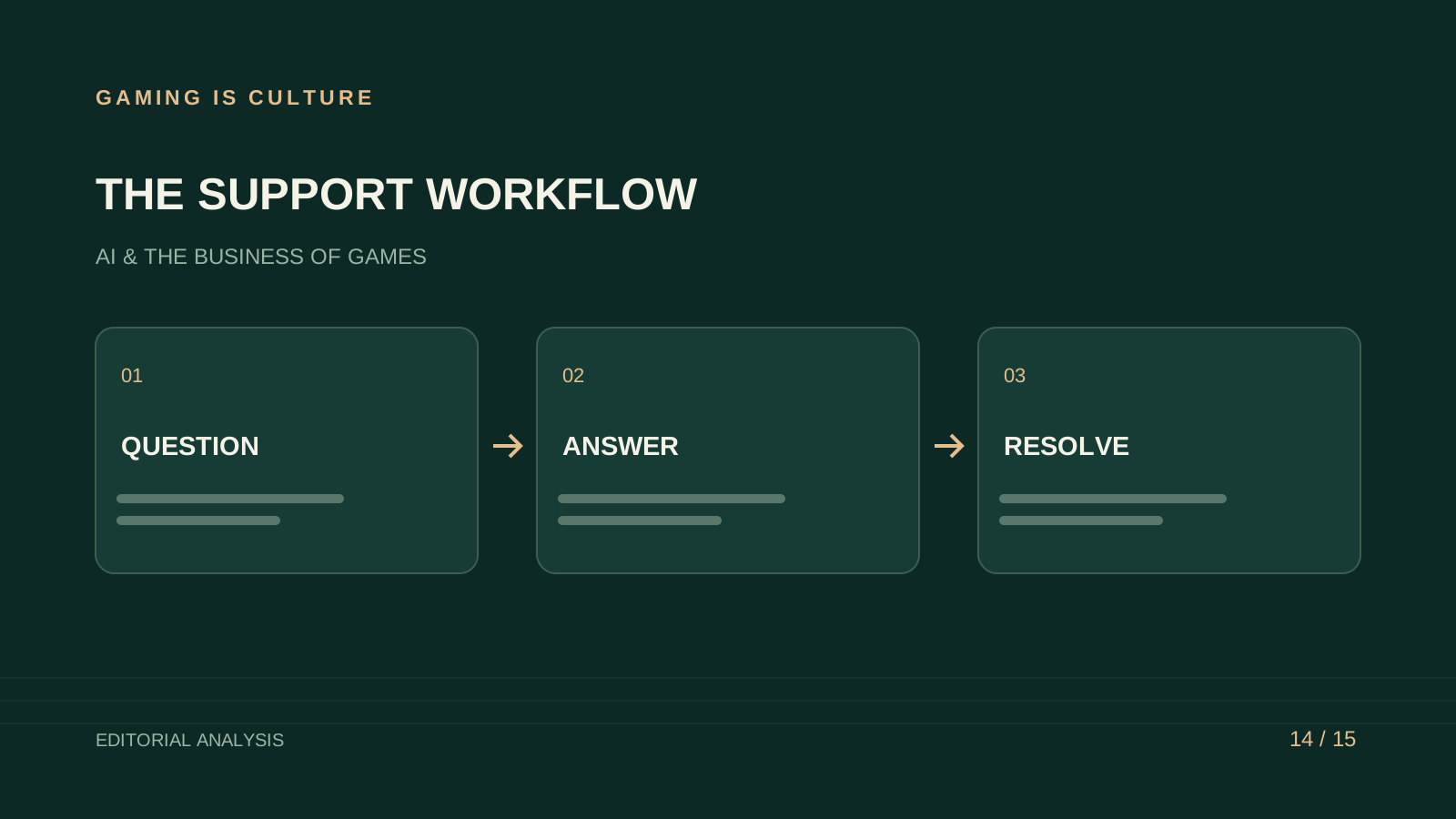
AI support can help players find approved troubleshooting steps and give human agents a more complete starting point. It can also frustrate players when it repeats the wrong advice, blocks escalation or treats an abandoned conversation as success.
The business question is whether the system reduces the cost of a satisfactory, lasting resolution. A lower visible ticket count doesn't establish that players received help or stayed with the game. This article models support economics and a pilot design; it doesn't claim a measured retention effect for a named game or a firsthand product trial.
Start with the ticket categories
Separate routine information from requests involving judgment or authority. Installation steps, supported controllers and published server status can be suitable candidates when the information is current.
Account recovery, disputed purchases, safety reports and ban appeals need specific rules and appropriate human involvement. A support bot shouldn't invent policy or make an irreversible decision because a player asks persuasively.
Count the volume, handling time and reopening rate for each category. A system can be valuable on one category and unsuitable for another. A broad automation percentage can hide that distinction.
Define resolution before measuring it
A useful resolution means the player's issue has been addressed under your support policy. A conversation ending can have several explanations: the player fixed the issue, gave up, disconnected or left to seek help elsewhere.
Choose measures that capture those possibilities. Track reopening, escalation, repeated contacts and satisfaction where appropriate. Review a sample of closed conversations manually.
Intercom's current pricing advertises Fin from $0.99 per outcome, with additional plan or seat arrangements depending on the setup. The definition and billing conditions of an outcome need review for the intended purchase. Intercom's official pricing is the source checked November 10, 2026.
Compare the full manual baseline
A human support workflow includes reading the request, gathering context, consulting policy, replying and following up. Some cases also require engineering or payment-provider involvement.
Measure a representative period and record category differences. A simple controller question and a complicated account recovery shouldn't share a single assumed handling time without qualification.
Include the cost of maintaining help articles. A clear knowledge base can reduce both human handling time and bot errors. If documentation is the main problem, improving it may be the most useful first investment.
Build a hypothetical assisted budget
Assume a game receives 5,000 monthly tickets. For illustration, a baseline average handling time is eight minutes and a chosen fully loaded planning rate is $30 per hour. The modeled handling cost is $20,000.
Now assume a pilot route handles 40% of tickets automatically, with 10% of those cases returning to a human for eight minutes. That leaves 3,200 human-handled cases, costing $12,800 under the same assumptions.
At an illustrative $0.99 for each of 2,000 billed automated outcomes, the modeled automated charge is $1,980. Add a chosen $500 allowance for administration and review, giving $15,280 before seat fees and other omitted costs. The modeled difference from baseline is $4,720.
These are hypothetical inputs. The calculation doesn't establish that a vendor achieves the assumed rate or that every automatically handled case is billable under those terms. Replace the assumptions with the contract and observed pilot data.
Reopening can erase the apparent saving
If many automated conversations return as longer human cases, the cost changes. A player may also need extra time to explain the issue again, which can affect satisfaction.
Track the chain of contacts under an appropriate case identifier. The goal is to understand the total work needed to resolve the problem, while respecting data and retention requirements.
Use a delayed review window. A case marked complete today may reopen after the player tries the instructions. Immediate completion counts can overstate lasting resolution when the underlying fix hasn't been verified.
Escalation should preserve context
Give players a clear route to a person when the request needs one. Carry over the issue, relevant account or build information and the steps already attempted. Avoid requiring the player to repeat an unhelpful troubleshooting loop.
Set escalation conditions by category. Repeated failure, missing documentation, sensitive requests and disputed outcomes should trigger the appropriate path. The support system should enforce these rules beyond the generated wording.
Measure whether escalation works under load. A handoff that sends the player into an unmonitored queue creates another failure. The team needs ownership and a response plan for those cases.
Keep game information current
A patch can change troubleshooting instructions, supported features or known issues. The support source needs a version and an owner.
Tie approved articles to the relevant platform and build where necessary. A PC workaround can be unsuitable for console players. A server incident should update the answer and direct players to the current status information.
When evidence is missing, the assistant should say what it needs and escalate appropriately. Guessing can create additional damage, such as directing a player to delete files without a suitable recovery process.
Protect actions with ordinary application rules
A support assistant may retrieve information or propose an action. The application should validate permission and policy before changing an account, issuing an entitlement or touching a payment-related workflow.
Limit access to the records needed for the case. A player message can contain hostile instructions, and the system shouldn't treat that message as authority to reveal internal information.
Use logs that support investigation without exposing unnecessary personal data. The team should be able to determine which information informed an answer and which action was authorized.
Retention needs a careful study
Players with support issues may already differ from the wider player base. Comparing bot users with all other players can produce a misleading retention conclusion.
Where appropriate, compare similar eligible cases across controlled or carefully matched groups. Define the outcome window and account for category, severity and platform. Document exclusions and limitations.
A small studio can begin with satisfaction, reopening and resolution quality before attempting a broader retention claim. If the evidence doesn't support attribution, describe the observed support outcome without saying the bot caused players to stay or leave.
A pilot for a live game
Choose a low-risk category with clear documentation, such as published setup guidance. Run the assistant in draft mode first so human agents can inspect proposed answers before players receive them.
Record corrections and identify recurring source problems. Update the help material and evaluation examples. Once the output meets the team's standard, consider a limited live rollout with a visible escalation route.
Keep a control or baseline where feasible. Review both easy successes and failed cases. The adoption decision should include the staff time needed to maintain the workflow during a patch or service incident.
Price the busy month
A launch, update or outage can multiply support volume. Model a peak month with the vendor's documented billing definition, any minimums and the human capacity needed for escalations.
Set spend alerts and clarify whether limits stop usage or only notify the team. A system that stops answering when its budget is exhausted needs a designed fallback.
Don't remove human capacity based only on the quiet pilot period. High-volume incidents often produce new questions that the knowledge base doesn't cover. The support plan needs people able to investigate and communicate under those conditions.
Evaluate the answer players receive
Review tone, accuracy and the usefulness of each step. A polite message can still be wrong. A correct policy explanation can still leave the player unsure how to proceed.
Use short, actionable instructions and ask only for information needed to help. Avoid making unsupported promises about refunds, fixes or timelines. The assistant should preserve the company's approved policy and clearly distinguish a known issue from a suspected cause.
Give human agents a way to report recurring errors and improve the source material. That feedback loop can benefit the whole support team, including cases handled without AI.
Audit a sample of apparently successful cases
Choose a recurring sample of conversations the system marked complete. Check the answer against current policy and the player's reported issue. Record whether the player had a practical next step and whether the case returned.
Include different platforms and request categories. A high-volume easy category can dominate the average while a smaller group receives poor answers. The review should reveal those differences.
Have the audit performed by someone able to identify policy and technical errors. A fluent answer can be persuasive even when it applies the wrong platform instructions. Keep the source used for the answer available for inspection.
Use the findings to revise documentation, eligibility rules and escalation. The goal is a better support process. An audit that only produces a score without changing recurring failures has limited operating value.
Prepare for a service incident
During an outage, many players may ask similar questions while the correct response changes quickly. Assign an owner for the current incident message and ensure the support system uses the approved version.
The assistant should avoid promising a repair time unless the company has authorized that information. It can explain the known issue, direct players to the status channel and gather only the details needed for investigation.
Set a path for cases that don't match the incident. A general outage message can become frustrating when it hides a separate account or installation problem. Keep escalation and category checks functioning.
After the incident, review the workload and costs. A burst can reveal limits, billing behavior and gaps in the knowledge base. Update the peak-month estimate using the observed data.
Keep human agents involved in improvement
Support staff see the recurring misunderstandings and the requests that fall between categories. Give them a simple way to flag a bad answer and link it to the relevant source or policy.
Allocate time to review those flags. A system that asks agents for feedback but leaves the same errors unresolved can increase frustration and rework. Assign owners to documentation fixes and workflow changes.
Share the limits with the team. Agents should know which cases are eligible for automation, which actions remain restricted and what information the assistant can access. This helps them explain the process to players and recover failures consistently.
When the workflow improves, compare the new result with the earlier baseline. Keep the measurement focused on lasting resolution and complete cost. That gives the company evidence it can use for staffing and service decisions without treating a vendor's completion metric as a full account of player experience.
A small game company can begin with a narrow support assistant and expand gradually. The team should be able to name the categories it handles well, the cases it escalates and the person responsible when the process fails. That operational clarity supports a better player experience during ordinary weeks and demanding releases.
Buy a better resolution process
AI support saves money when it handles suitable requests accurately, keeps repeat contacts low and gives human agents more useful context. It becomes costly when apparent deflection hides abandoned or unresolved cases.
Start with one category, measure lasting outcomes and count the complete cost. Expand after the team can explain the benefit and recover failures. Claims about retention should follow an appropriate study of the game's players.
Sources and method
Intercom is cited for its own advertised pricing structure. All ticket volumes, handling times, automation rates, labor assumptions and savings in the example are hypothetical. No causal retention result or firsthand product benchmark is claimed. Sources checked November 10, 2026. Review the selected vendor's current outcome definition, data terms and complete quote before purchase.
Sources and further reading
Source-based reporting and analysis. Research checked November 10, 2026.