The takeaway
An automated testing tool can repeat actions, explore supported game states and collect evidence without a person manually performing every run. Whether it improves your QA process depends on coverage, integration, reproducibility and the time required to investigate its reports.
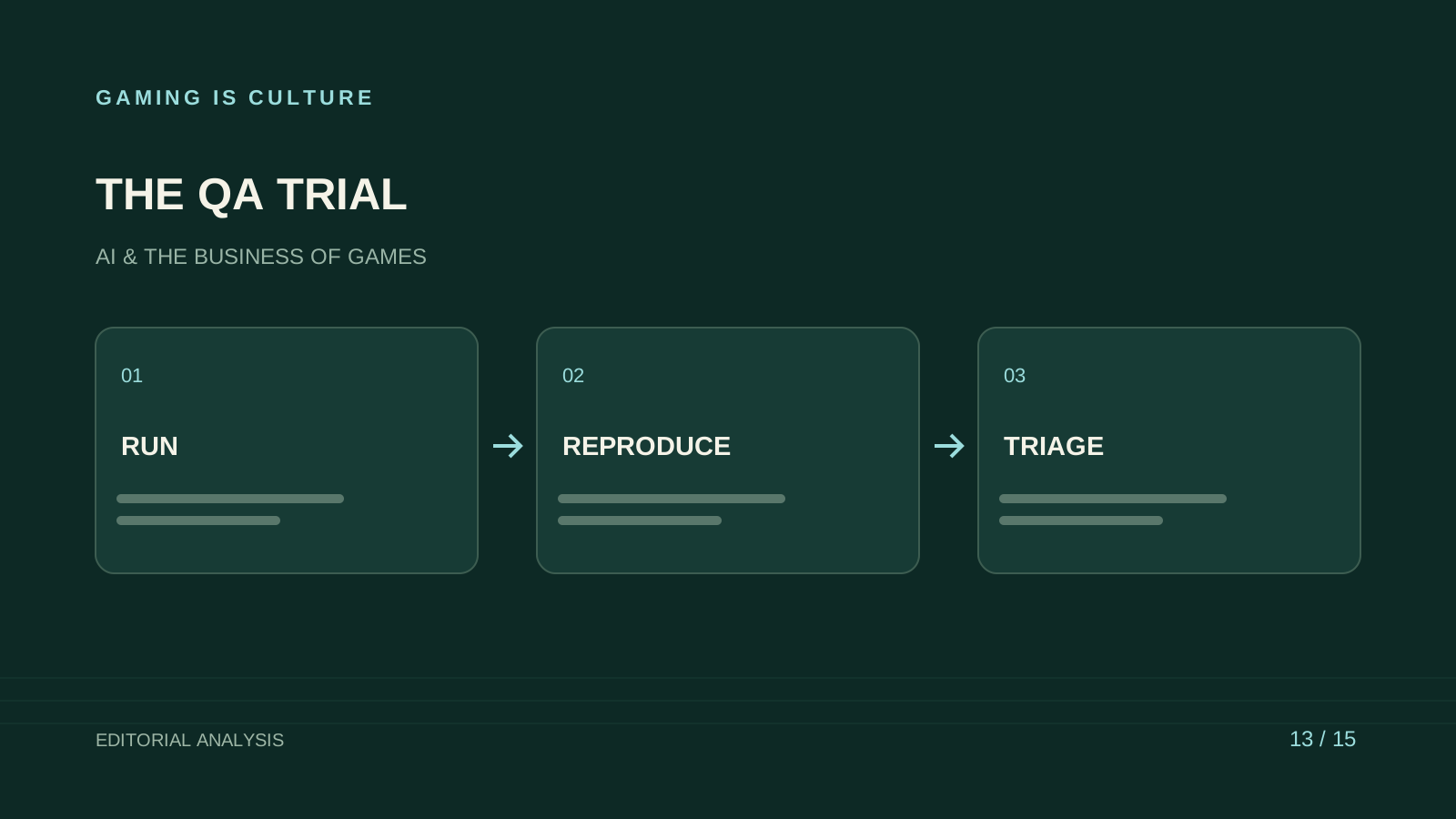
Gaming Is Culture hasn't conducted the trial implied by this headline, so this article doesn't name a tested winner. It examines what a credible trial must measure and where automated tools fit beside human QA. A vendor demonstration or a large run count can't establish that a tool can replace the work your release requires.
Define the QA job before comparing products
Game QA includes checking known behavior, exploring unexpected interactions, evaluating usability and investigating platform-specific problems. These tasks require different methods and evidence.
An automated route through a level can detect a crash while missing a confusing objective. A script can verify a calculation while saying little about controller navigation. A human tester can recognize a troubling interaction that the test plan never anticipated.
List the jobs you expect the tool to perform. Specify the supported engine, build type, target platform and access available to the automation. The result should be a comparison against the intended work, with limitations recorded explicitly.
Establish a baseline with ordinary tests
Before adding an AI testing service, inventory your existing unit, integration and scripted gameplay checks. A deterministic test can be appropriate when the expected behavior is already known.
Unity's Test Framework supports tests in Edit Mode and Play Mode. That gives Unity teams a way to validate different categories of project behavior, while leaving other checks to platform testing and human play. Unity's official guide explains the framework.
A new AI tool should show what it adds to that baseline. If it repeats a reliable existing check at higher cost, the purchase needs another justification. If it explores states the current suite doesn't reach, measure that additional coverage.
Investigate integration before paying for volume
An AI testing product may require an SDK, instrumentation, training, scene setup or a cloud build pipeline. Confirm support for your exact engine version and the environment where tests will run.
Modl.ai publishes technical documentation and FAQs for its testing workflow. Those materials are useful starting points for compatibility questions, but they don't establish that a particular studio's project will integrate successfully. The vendor's FAQ is a primary reference to review with the supplier.
Budget a limited integration spike. Record engineering hours, build changes and the work required to create a useful run. Include how the integration will be maintained after engine or game updates.
Build a trial containing known defects
Create a controlled test build with seeded defects that represent your game: a broken transition, a missing interaction, a reproducible crash and a progression blocker. Keep the list separate from the tool operator where practical.
Also include a clean build or clean scenarios. A tool that reports many problems needs to demonstrate that it can distinguish defects from expected behavior. Otherwise its output can consume more investigation time than the team can afford.
Use appropriate nonproduction data and keep the trial isolated. A testing agent shouldn't have permission to change live accounts, payments or player inventories while exploring behavior.
Measure discovery and reproducibility
For each report, ask whether it describes a valid issue and whether another tester can reproduce it. Capture build identifier, environment, steps, logs and relevant footage.
A useful report points the developer toward a fix. A vague warning that something looked unusual may still deserve investigation, but its cost differs from a reproducible crash with a clear trace.
Count unique valid defects after deduplication. A hundred reports caused by the same issue shouldn't become a claim of a hundred separate bugs. Record severity and discovery timing so the team can see whether the tool finds problems early enough to matter.
False positives belong in the cost model
Suppose a hypothetical run produces eighty reports, of which twenty are valid and distinct after review. If each report takes five minutes to investigate, the review burden is 400 minutes, or six hours and forty minutes.
At a chosen $40 hourly planning rate, that is about $266.67 before fixes and subscription costs. These are illustrative assumptions, not a measured vendor result. The example shows why report volume alone can be misleading.
Track false negatives too: seeded issues the tool misses and important defects found later by humans. A low false-positive rate doesn't help if the tool never reaches the critical states your game needs tested.
Coverage needs a game-specific definition
A testing tool can cover actions, scenes, code paths, states or devices. Those measures aren't interchangeable. A bot visiting every room may still miss a quest condition requiring a specific earlier choice.
Define important state combinations and progression paths. Include save loading, inventory limits, interrupted sessions and platform behavior relevant to the release. Explain which parts the tool can exercise and which remain outside its scope.
Use coverage as evidence of exercised behavior, with an appropriate limit. No practical test campaign proves that a complex game contains no defects. The team still needs risk-based decisions about where to spend testing time.
Human QA evaluates the experience
A player can become confused without the game violating a simple technical rule. The objective may be unclear, a subtitle difficult to read or an interaction unpleasant with a controller. These issues need an evaluation method suited to human experience.
Include accessibility and usability review in the test plan. A tool that navigates successfully doesn't establish that a player with different needs can do the same. Technical success and player experience require separate evidence.
Human testers also interpret patterns across reports and communicate with designers. An automation purchase should describe how it supports that work and who owns the resulting decisions.
A hypothetical monthly comparison
Assume an automated testing route has a chosen $300 service allowance, ten setup hours allocated over three months and eight hours of monthly report review. At $45 per hour, setup allocation is $150 and review is $360, producing a modeled $810 monthly total before other infrastructure.
Compare that with the cost and coverage of the existing process. If the tool removes repetitive overnight checks while finding important defects, the investment may be useful. If reports require substantial triage and duplicate current coverage, the result may be weaker.
The model doesn't price a named vendor. Obtain an itemized quote covering runs, devices, concurrency, storage and support, then substitute observed integration and review effort.
Test maintenance after a game update
A tool that works on one build may need adjustments after menus, levels or interaction rules change. Include a representative update in the pilot and record the effort required to restore useful tests.
Ask whether the tool can distinguish an intended design change from a regression. The team needs a process for updating expected behavior without hiding new defects.
Store the configuration and test evidence in the project's normal records. Another engineer or tester should be able to rerun a case and understand what changed. Avoid depending on undocumented settings in one employee's account.
Review data and build handling
A cloud testing service may receive unreleased builds, logs and potentially sensitive information. Confirm retention, access, deletion and the supplier's permitted use of those materials.
Use test accounts and suitable sample data. Remove unnecessary credentials and personal records from the build. A nondisclosure agreement is one part of the arrangement; the technical access still needs to match the task.
Ask how evidence is exported if the service is canceled. Bug reports and reproducibility data should remain usable by the studio after a vendor change.
Ask the vendor for evidence you can inspect
Request a description of the supported workflow, integration requirements and limitations. A case study can be useful when it explains the project, task and measurement, while a headline percentage alone leaves too many unanswered questions.
Ask whether reported bugs were deduplicated and independently confirmed. Clarify whether the advertised time saving includes setup and triage. If the vendor provides a trial, agree on the evidence it will return and the data it will receive.
Keep a written record of unsupported requirements. If the tool doesn't cover your target device or engine configuration, don't assume support will arrive before your deadline. The production plan needs a workable route under current capabilities.
Use the vendor's answers to narrow the pilot. A limited test of a supported job can produce a useful purchase decision even when the product can't address the entire QA workload.
Evaluate evidence quality after a failure
A crash report should help the team reproduce and investigate the issue. Review whether logs, timestamps and footage align with the same build and session.
A video showing a character stuck in geometry can be useful, while the missing state that caused it may make reproduction difficult. The team needs enough information to determine whether the behavior is a defect and how it occurred.
Ask another tester to reproduce a sample using only the returned report. Record the time and any missing details. That exercise measures whether automation is reducing investigation work or moving it to someone else.
For intermittent issues, preserve the available evidence and state uncertainty. A tool should avoid inventing deterministic steps when the cause hasn't been established. The report can remain valuable as an observation requiring further investigation.
Include a release-week rehearsal
Run the testing workflow on a candidate build under the schedule the team expects near release. Measure how long preparation, execution, triage and reruns take.
A large overnight run is useful only if the team can review the results before the next decision. Reports arriving after the build deadline may have less immediate value. Set priorities so critical failures appear in a manageable queue.
Simulate an unavailable testing service or broken integration. The studio should know which checks can continue manually and which release decisions would be delayed. A fallback belongs in the QA plan.
Use the rehearsal to assign ownership. Someone needs to maintain the integration, someone needs to triage reports and someone needs to decide whether a finding blocks release. The tool doesn't remove those responsibilities.
After the rehearsal, compare the added coverage with the cost of running and maintaining it. If the workflow finds useful defects and fits the team's decision cycle, it has a specific role. If it produces an unreviewable pile of reports, narrow the scope or change the process before expanding usage. A credible trial can support either outcome without pretending the product replaces every part of QA.
Define a purchase threshold before the trial
Set the conditions that would justify adoption: acceptable integration effort, reproducible reports, useful new coverage and manageable maintenance. Include a maximum spend and a date for the decision.
Run the trial long enough to encounter representative changes, while keeping it bounded. A successful demonstration can justify the next stage; it shouldn't automatically become a commitment to remove human QA capacity.
The tool survives a credible trial when it improves the team's tested coverage or release confidence at a cost the studio can maintain. That conclusion needs the trial evidence. Until then, product claims remain claims to investigate.
Sources and method
This is a researched evaluation plan, not a completed comparative review. No vendor scores, discovered bugs or replacement claims are invented. Unity and modl.ai are cited for their own technical information. All workloads and budget numbers are hypothetical. Sources checked November 10, 2026; compatibility and pricing require a current vendor-specific check.
Sources and further reading
Source-based reporting and analysis. Research checked November 10, 2026.