The takeaway
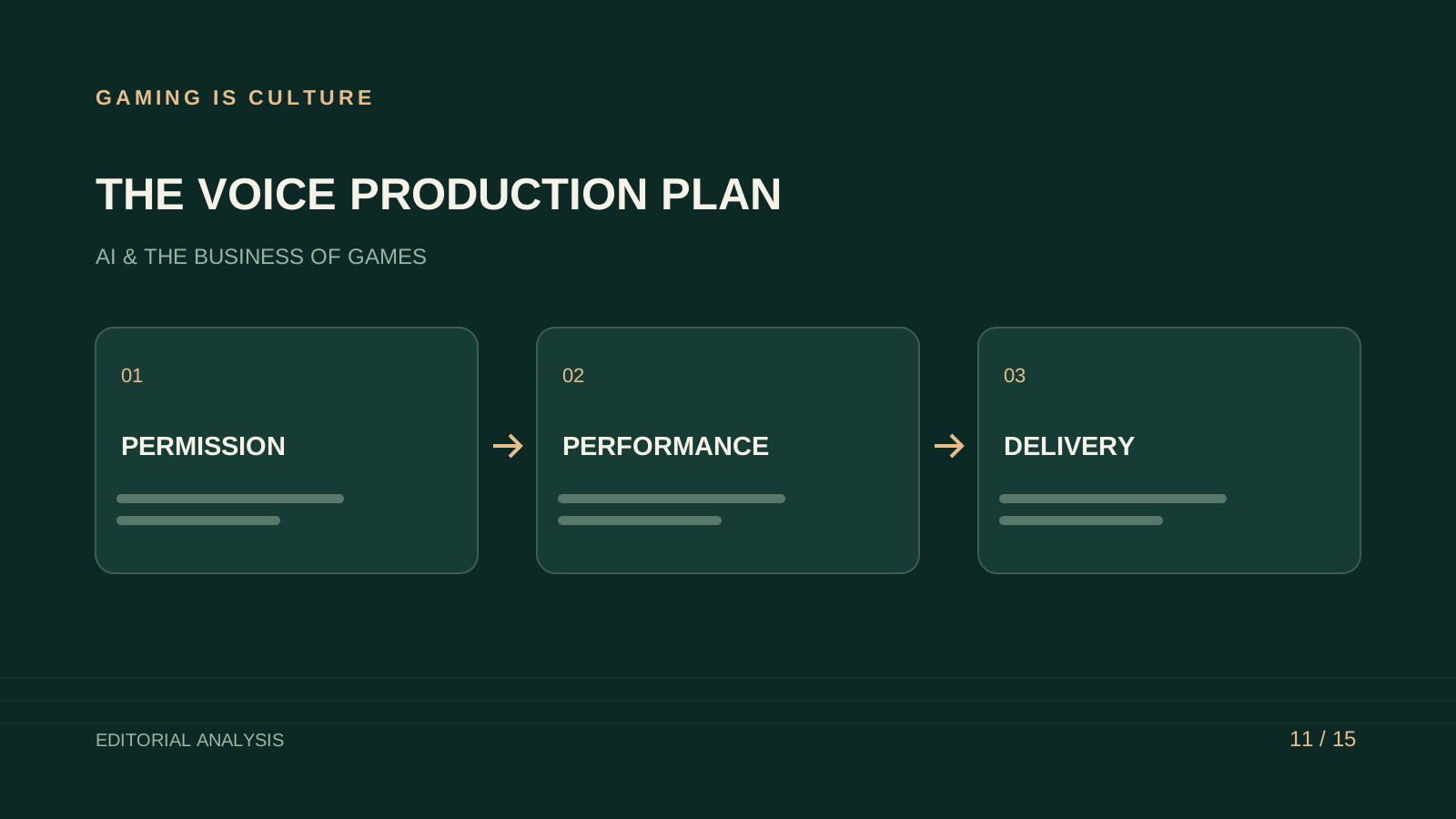
Choosing voice production for a game involves performance, direction, revision and permission. A generated minute and a recorded actor's minute can have very different costs and contractual conditions. A subscription price doesn't tell you whether the finished dialogue fits the character or whether the intended use is authorized.
A small studio can use a clear script and a defined production brief to compare the routes. This article provides a budgeting and contract-review framework with hypothetical examples. It doesn't offer legal advice or claim that Gaming Is Culture has tested the services or obtained quotes from performers.
Decide what the voice must accomplish
Temporary dialogue used to check scene timing has different requirements from a lead character's final performance. A menu instruction, a cinematic conversation and a branching companion scene also need different direction and review.
Define the character, emotional range, language, expected volume and revision needs. Include how the voice will be used in trailers, social clips, expansions and future updates. The scope affects both the quote and the agreement.
A voice that sounds clear in one line may struggle across a long scene. Build a sample containing the difficult material: a name, an interruption, a restrained emotional beat and a line requiring continuity with another speaker.
Budget the complete human session
A performer quote may include session minimums, usage, pickups, direction and other agreed terms. Costs vary by performer, production, market and applicable agreement. Obtain a written quote for your scope instead of importing a generic per-minute rate.
The studio also needs preparation, casting, recording arrangements, file editing and implementation. A well-organized script can reduce avoidable retakes and make the session more productive.
Keep the performer involved in pronunciation and character notes where the agreement allows. Direction is part of the production process. The budget should reflect the performance the game needs, including time to achieve it.
Budget generated voice by the usable result
A generation service may meter characters, credits, minutes or model-specific usage. Repeated takes and pronunciation corrections can increase consumption. Include editing and listening time in the estimate.
ElevenLabs' current pricing page lists paid plans that include a commercial license, while its billing documentation distinguishes plan and credit arrangements. A commercial-use permission from the service remains subject to its terms and your rights in the supplied material. ElevenLabs pricing and billing documentation are the references checked November 10, 2026.
Don't apply one model's conversion rate to every voice feature. Check the intended model, voice and generation settings. A budget based on the lowest advertised unit can understate the cost of the workflow your audio lead approves.
Consent needs a defined scope
Using someone's recordings to create or operate a voice replica raises permission questions beyond the ability to upload a file. The agreement should identify the performer, authorized uses, compensation, duration and restrictions.
A broad sentence hidden in a general services agreement may leave the parties with different expectations. Have the relevant rights reviewed explicitly. Include whether the voice can appear in sequels, downloadable content, advertising or player-generated dialogue.
SAG-AFTRA's 2025 Interactive Media Agreement materials address digital replicas and consent for covered work. Their application depends on the production and agreement. SAG-AFTRA's official resources are the starting point for understanding those provisions.
A tool license and a performer agreement do different work
A vendor may authorize commercial use of its output under specified terms. That doesn't establish that a studio has permission to imitate a particular performer, character or public figure.
Check the source of the voice and the permissions that follow it. A library voice, a custom recording and a replica made from supplied samples can have different conditions. Keep the relevant documents beside the production record.
If the intended use changes, review the scope again. A voice approved for internal timing may need additional permission before appearing in a shipped game or public trailer. The team should know who can authorize that change.
Compare a hypothetical dialogue batch
Assume a project needs 600 short lines. For planning, separate script preparation, performance or generation, editing, review, implementation and pickups. Ask human providers for an itemized quote and calculate the generated route using the selected service's billing unit.
For an illustrative generated workflow, suppose software allocation is $80, editing takes eight hours and review takes six hours. At a chosen $40 hourly planning rate, the modeled total is $640 before integration, rights work and other costs.
This isn't a quote or a claim that 600 lines can be produced to an acceptable standard for that amount. The example shows why the software invoice can be a small part of the budget. Replace each assumption with a pilot and the required contracts.
Use a sample scene to evaluate performance
Choose a scene representative of the game, with permission to use the material. Evaluate intelligibility, emotional continuity, pronunciation and how the lines work together. Review the scene in the game where possible.
For a human route, a paid audition or sample arrangement can establish fit under agreed conditions. For generated voice, record every take and correction required to reach the approved result. Avoid comparing a carefully directed human scene with a single casual generation or the reverse.
A sample can reveal a hybrid workflow. Temporary generated dialogue might help development while a performer records final scenes. Any temporary material still needs suitable rights, and the team must ensure it doesn't accidentally ship.
Plan revisions before recording
Games change. Quest logic, names and timing can create pickups after the main session. Clarify how revisions are quoted, delivered and approved.
For generated voice, check whether the selected voice and model will remain available and whether earlier settings can be reproduced. A future update should maintain the intended character without depending on undocumented account history.
Keep line identifiers stable. Each file should trace to the script version, speaker, take and approval. That organization reduces the chance of implementing an outdated line and makes localization or later corrections easier.
Player-facing generated dialogue adds operations
A live conversational character can produce lines during play. That introduces moderation, response timing, failure handling and ongoing usage costs alongside voice licensing.
The performer agreement needs to address the intended generative use. The game's systems also need to limit what the character can say and do. A voice model shouldn't become authority to grant items, reveal private information or make unsupported promises to players.
Provide a fallback when generation is unavailable. A recorded response or a designed silent interaction can preserve the game experience. Count the engineering and review needed to support that behavior.
Localization changes the comparison
A translated script needs language review and performance direction appropriate to the audience. Pronunciation, register and character tone can shift between languages. A tool supporting a language doesn't establish that its output meets the game's standard.
Budget qualified review and clear correction instructions. If a human performer is involved, define the language and usage scope. If a replica or dubbing system is used, confirm the relevant consent and service terms.
Test the delivered audio inside the game. Subtitle timing, line length and interaction pacing can reveal problems that a standalone audio file hides. The approved deliverable is the implemented scene.
Keep evidence for later use
Archive contracts, voice permissions, vendor terms applicable to the purchase, script versions and approved files. Record generation dates and settings where relevant. A publisher or platform review may require the team to explain the production chain.
Ask how access can be removed when a contractor leaves and what happens to a custom voice model if the service is canceled. The contract and technical workflow should support the agreed outcome.
For disputed or uncertain rights, pause use of the affected asset and obtain appropriate advice. A replacement plan is easier to execute when each line and voice has a clear record.
Budget silence, timing and interaction
A voice file can sound good alone and fail inside a scene. The line may arrive too late, overlap another speaker or require a different pause to match the animation.
Review a representative sequence in the game and record the implementation effort. Include file naming, subtitle alignment, volume consistency and transitions between lines. These tasks exist for both generated and human-recorded dialogue.
If the game supports branching conversations, test neighboring paths. The emotional state at the end of one line should make sense at the start of the next possible reply. A collection of individually polished files may still need direction as a scene.
Use the sample to estimate pickups and editing. The studio can then ask for a more accurate human quote or calculate a more representative generated workload. The finished interaction is the unit that matters to the player.
Make permissions understandable to the performer
A clear agreement should let the performer understand what the studio plans to do. Describe the game, media, duration and any generated use in plain terms alongside the formal contract language.
If the project involves a replica, address access to the model, permitted operators and future changes. Clarify how questions or disputes will be handled and which uses require another discussion. Obtain qualified advice for the agreement.
The production team needs the same clarity. An editor preparing a trailer should know whether the voice can be used in advertising. A designer planning an expansion should know whether the earlier permission covers it.
Keep those decisions connected to the voice asset record. A signed document stored somewhere in an unrelated folder can be difficult to apply during a busy release. A concise usage note can point teammates to the controlling agreement without replacing it.
Compare a hybrid plan explicitly
A studio might use authorized temporary speech during development and commission final performances for major characters. It might also choose recorded lines for important scenes and a separately authorized generated system for limited ambient dialogue.
Price each part and the transition between them. Temporary files need labels and a removal checklist. Final recording needs a stable script and a plan for replacing placeholders. Live-generated dialogue needs ongoing operations and an agreed permission scope.
The hybrid route can become expensive if the team treats temporary work as finished and later rebuilds the entire implementation. Use stable line identifiers and keep the production status visible.
Evaluate the player experience across the boundary. A generated ambient voice and a recorded lead performance may differ in delivery or sound. The audio lead should approve the combination and the contexts where each appears.
A clear plan gives the studio flexibility without leaving permission, quality or replacement decisions until the final week. It also makes the comparison with an entirely recorded or entirely generated route more meaningful because all routes use the same intended scope.
Choose the production route the game needs
A human performance can offer direction, interpretation and collaborative choices that matter deeply to a character. Generated voice can serve selected workflows when the quality, permission and operating conditions fit. A hybrid arrangement can also be suitable with clear boundaries.
Compare the complete cost of approved dialogue and its future maintenance. Make the choice after a representative sample, written scope and rights review. That gives the studio a budget it can defend and performers a clearer understanding of how their work will be used.
Sources and method
This is a researched production guide, with hypothetical costs and no firsthand audition or product trial. ElevenLabs is cited for its own commercial-plan and billing information. SAG-AFTRA is cited for resources concerning covered interactive work. Legal and contract outcomes depend on the agreement, jurisdiction and production; consult qualified counsel for the specific project. Sources checked November 10, 2026.
Sources and further reading
- elevenlabs.io · pricing ↗
- elevenlabs.io · billing ↗
- sagaftra.org · 2025 interactive media video game agreement ↗
Source-based reporting and analysis. Research checked November 10, 2026.