The takeaway
A studio asking for a custom AI model may need a searchable knowledge base, a carefully prompted existing model or a narrow fine-tune. Training a model from scratch is a larger project with different data and compute requirements. Clarifying the intended behavior can prevent the team from paying for the wrong approach.
The complete budget includes data rights, preparation, evaluation, experimentation, deployment and maintenance. Compute is one line in that budget. This article uses explicit hypothetical estimates to explain the choices, with no claim that Gaming Is Culture has trained or benchmarked the described models.
Define the problem in observable terms
Write the behavior the system should improve. A studio might want an assistant to answer questions from approved design documents, classify support tickets or produce dialogue drafts in a consistent format.
Each problem needs a different success measure. A document assistant should cite the right current source and decline when the material doesn't support an answer. A classifier should assign the correct category on examples it hasn't seen during development. A dialogue tool needs editorial review against a defined brief.
Avoid beginning with a model size or a GPU purchase. The team needs a baseline and a test set before it can know whether customization helps. A smaller intervention may meet the requirement at lower cost.
Try a prompted baseline
Give an existing model clear instructions, representative examples and the relevant source material. Measure its performance on a held-out set of tasks. Record errors and the review required.
A formatting problem may improve through a better output schema and validation. A knowledge problem may improve through retrieval from approved documents. A repeated behavioral pattern may justify exploring fine-tuning.
Keep the baseline result. Every more expensive approach should be compared against it. Without that record, a team can spend weeks building a custom system and still be unable to explain whether it improved the original task.
Retrieval keeps changing knowledge outside the weights
A retrieval system searches a controlled collection and supplies relevant material to the model. For a studio with changing design documents, that can make updates easier to manage because the approved source can be replaced without retraining the model.
The work includes cleaning documents, setting access rules, choosing retrieval behavior and checking whether the correct passages reach the answer. A search failure can produce a poor answer even when the model itself is capable.
Test outdated versions and access restrictions. A contractor shouldn't receive material outside their permissions, and an old specification shouldn't override an approved change. The document system needs ownership and versioning.
Fine-tuning changes behavior through examples
Fine-tuning adapts an existing model using a training dataset. It can be useful for a narrow repeated behavior when the team has good examples and a measurable target.
Hugging Face documents parameter-efficient methods such as LoRA, including approaches that combine quantized models with small trainable adapters. These can reduce the resources required compared with updating every parameter, while leaving data preparation and evaluation work in place. Hugging Face's PEFT documentation explains the approach.
Don't assume a fine-tune becomes a reliable database of every production detail. Evaluate whether it improves the chosen task and whether it introduces unwanted behavior elsewhere. Keep a rollback to the previous model or baseline.
Training from scratch is a separate undertaking
Starting with randomly initialized weights requires a training plan, suitable data, architecture choices, compute and expertise. A small specialized model can be a legitimate research or product project, but the label custom doesn't establish that this route is necessary.
For a small studio needing internal document help, training from scratch can introduce costs unrelated to the immediate need. The company should explain why an existing model plus controlled data cannot meet the requirement.
If the goal is a distinctive player-facing system, evaluate it as a product investment. Include integration, safety, latency and ongoing operations, alongside the model development. A successful training run alone doesn't make the feature ready to ship.
Data preparation is a production job
Collecting examples requires rights and permissions appropriate to the intended use. A folder containing scripts, contractor work and player messages may have several different restrictions.
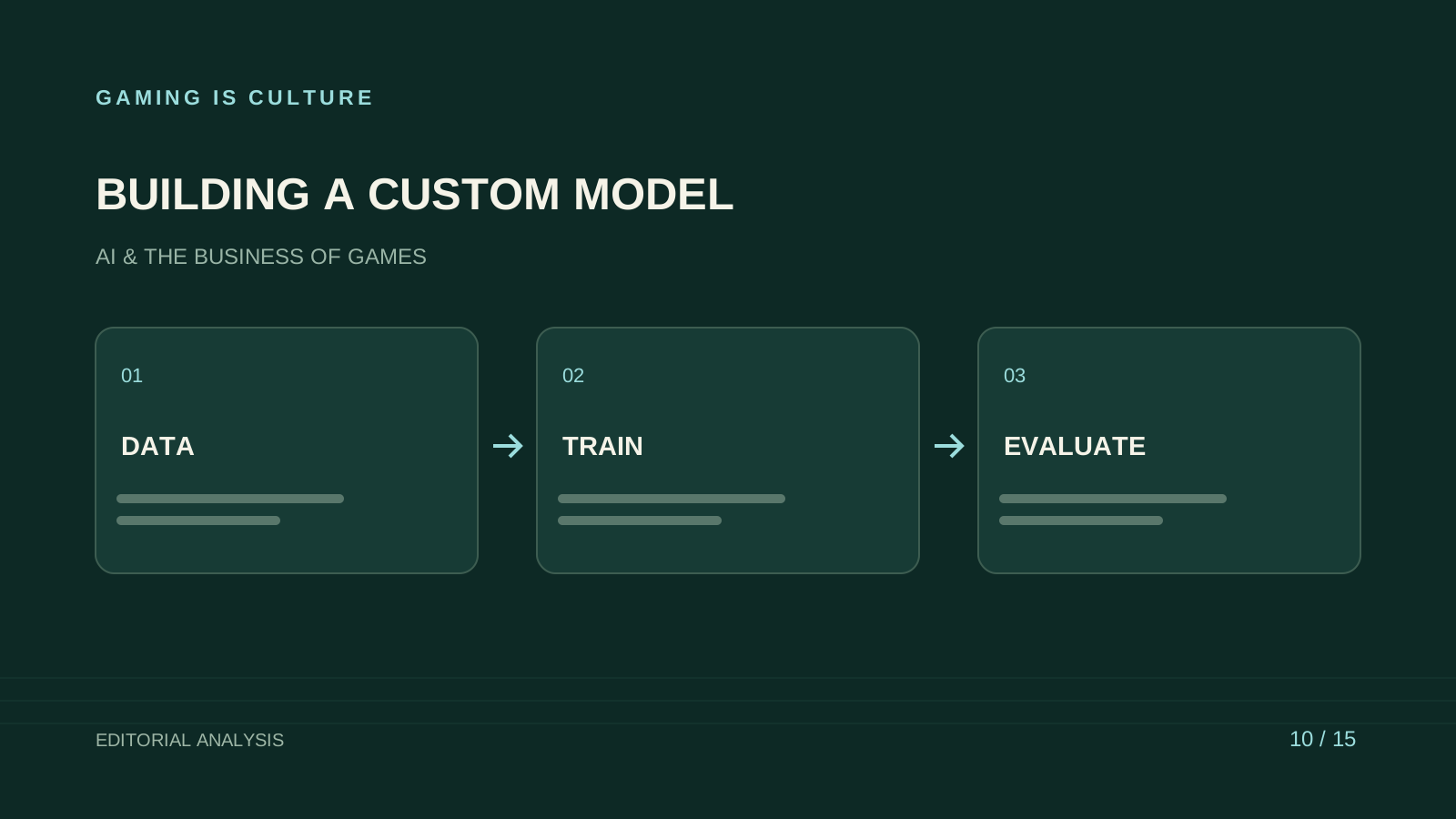
Clean the examples and remove material that shouldn't enter training. Define consistent labels and resolve disagreements. Keep records of where the data came from and the decisions made during preparation.
Separate training, validation and final evaluation examples. If the system is scored on near-duplicates of its training material, the result can overstate its ability to handle new work. A reviewer should understand how the sets were created.
A hypothetical fine-tuning budget
Consider a narrow ticket-classification experiment. Assume twenty-five hours of data preparation, twelve hours of evaluation design, eight hours of engineering and a chosen compute allowance of $150. At a planning labor rate of $50 per hour, the modeled initial cost is $2,400.
Add ten hours for integration and documentation, giving a modeled launch total of $2,900. These are chosen assumptions and aren't a vendor quotation or an industry average. Another task could need far more data work or fail to benefit from fine-tuning.
If the studio performs three experiments, don't count only the successful run's compute bill. Record the complete development expense. The business paid for rejected approaches and reviewer time too.
Model the continuing cost
A custom model still needs inference, monitoring and maintenance. Hosting may require a minimum deployment charge or dedicated compute. Other arrangements meter requests or tokens. Use the selected provider's current quotation.
Assume an illustrative $100 monthly hosting allowance and four maintenance hours at $50 per hour. The continuing modeled cost is $300 monthly. If usage grows, include the extra compute and the staff effort needed to investigate failures.
A model that changes slowly can still need updates when the game, support categories or source data change. Name the person responsible and set a review schedule. Unowned model maintenance becomes another production risk.
Compare with the cheapest adequate baseline
Suppose the custom workflow costs $2,900 initially and $300 monthly. A prompted or retrieval-based alternative might have a lower initial cost and a different ongoing bill. Compare both against the same acceptance standard.
For an illustrative twelve-month view, the custom route totals $6,500 under those assumptions. If an alternative costs $800 to set up and $180 monthly, its modeled total is $2,960. The custom route would need enough additional value to justify the $3,540 difference.
These numbers demonstrate the method. They don't establish which route wins for a studio. Quality, confidentiality, latency and control can all affect the decision, but each claimed benefit needs evidence.
Test the failures your game can afford
For an internal classifier, inspect misrouted tickets and the recovery process. For a document assistant, test unsupported questions and conflicting versions. For player-facing dialogue, include adversarial requests and attempts to trigger unauthorized actions.
Set a threshold before evaluating the final holdout set. Repeatedly editing the system against the same examples can turn the test into another training set. Keep a separate final check for the decision to deploy.
Monitor after launch. A new content update can change the distribution of requests and reveal weaknesses absent from the pilot. Store enough appropriate evidence to investigate without retaining unnecessary sensitive material.
Keep model and data rights together
The base model's license, training-data permissions and deployment terms all affect the finished system. An adapter can depend on a base model with its own conditions. A provider's commercial plan doesn't automatically resolve rights in the examples you supply.
Maintain a record of model versions, licenses, datasets and approved uses. If the model is shared with a publisher or contractor, confirm what can be transferred and under which terms.
For legal or contractual questions, obtain advice suited to the exact assets and jurisdiction. This article supplies a planning framework and doesn't determine ownership or liability for a particular training project.
Create a small, useful evaluation set
A studio can begin with a collection of examples representing the decisions the system will face. For ticket classification, include clear cases, ambiguous cases and requests that should be routed to a person.
Have qualified reviewers establish the expected labels and resolve disagreements. If humans can't agree on the categories, a model score may reflect an unclear policy. Fix the category definitions before investing in training.
Keep the final evaluation examples separate from development. Record where each example came from and which version of the policy it follows. If categories change, update the evaluation deliberately and retain the older result for context.
Inspect errors by category. A high overall score can hide weak performance on a rare but important request type. The deployment decision should consider the consequence of a mistake as well as its frequency.
Account for failed experiments
A customization project may require changes to the data, training settings or model choice. Budget a bounded experiment allowance and define what would justify another run.
For each attempt, record the hypothesis, configuration, compute expense, staff time and evaluation result. A run that doesn't improve the baseline still provides information, but its cost belongs in the project total.
Set a stopping condition. If the remaining errors come from missing source information or unclear policy, more training may be the wrong intervention. Improving the documents or adding a human escalation route can be more practical.
A small studio benefits from a decision point after the first useful comparison. The team can choose to continue, narrow the scope or retain the simpler baseline. That keeps model development from becoming an open-ended side project.
Design deployment before the final training run
The model needs a place to run, a version identifier and a way to return to a previous configuration. Define those elements before treating the experiment as ready for production.
Test the complete request path with suitable sample data. Include input validation, permissions, inference, output checking and the fallback. A strong offline score doesn't establish that the deployed service will respond within the needed time or handle unavailable dependencies.
Keep the previous model or baseline accessible during rollout. A limited release can expose issues while preserving a practical recovery path. Record the conditions that trigger rollback and who can make that decision.
Document the model's intended scope for teammates. A classifier trained for support categories shouldn't quietly become a general authority for policy decisions. A narrow description of supported use helps the studio avoid attributing capabilities the evaluation never established.
After launch, compare the new request distribution with the evaluation set. If the game adds a platform, language or feature, review whether the model still fits. Continuing usefulness requires maintenance of the task definition as well as the model files.
A studio-sized decision
Begin with a narrow problem, a prompted baseline and a held-out evaluation set. Add retrieval when the main need is current controlled information. Investigate fine-tuning when repeated behavior remains a measurable problem and suitable data exists.
Training from scratch should have a specific technical and business justification. A studio can gain useful control through simpler methods without taking on a separate model-development program.
The defensible cost is the full price of a dependable deployed behavior: people, data, experiments, hosting and maintenance. Counting that total gives a small company a stronger basis for deciding whether customization belongs in its production plan.
Sources and method
This is a researched planning guide with hypothetical budgets and no claimed training experiment. Hugging Face's quantization guide supports the discussion of efficient adaptation methods. Amazon Bedrock's model customization documentation describes a managed customization workflow. Sources checked November 10, 2026. Provider-specific compute and deployment prices require a current configuration-specific quote.
Sources and further reading
Source-based reporting and analysis. Research checked November 10, 2026.